
Behind the Scenes @ ZeroAvia
Read the transcript
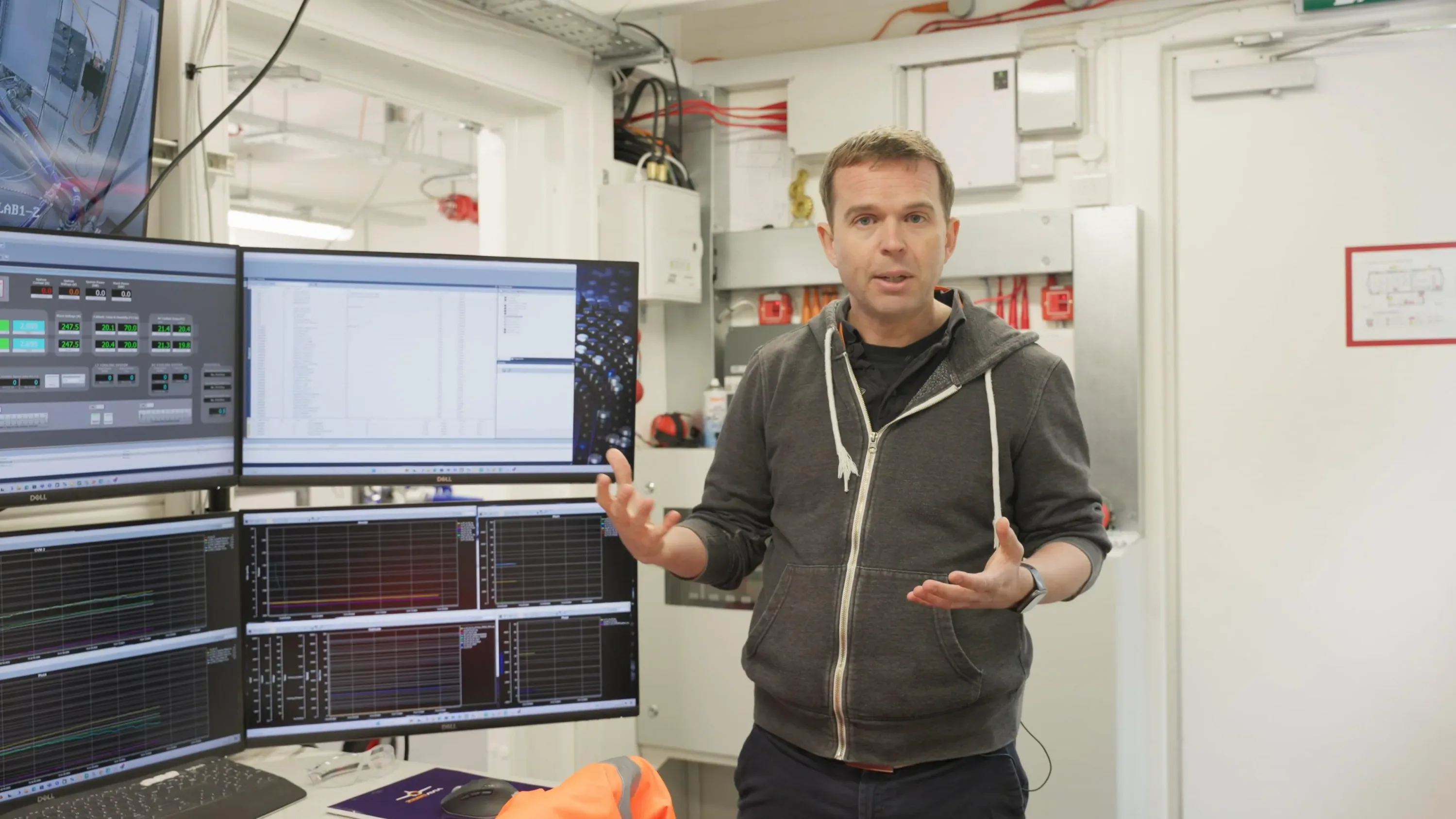
Hello, my name is Dr. Gareth Coates and I'm here today at Kemble to talk about a really new exciting capability that we've developed. We are using hydrogen fuel cells to decarbonise aviation. Now there's a lot of strong challenges with that and the most abundant of which is how do you test fuel cells in an aviation context.
Now, on that journey to certification, we can't just put that straight into an aircraft. We have to be sensible about testing those things on the ground. And what we have behind us is a really significant lab that allows us to do that. So follow me and we'll show you around the lab and show you some of its exciting capabilities.
So what's so important about this lab and what makes it so special? Well, obviously testing fuel cell in aviation context is quite a complex and difficult thing to do, and this lab allows us the freedom and the space with which to operate these fuel cells at extremely high powers and different conditions to make sure we're pushing the boundaries. When you're operating at the megawatt scale, you know, you have to take into considerations a whole host of safety and engineering issues, and this lab in which we see around us allows us to do that in a safe way. So the building takes care of high voltage safety issues and also gaseous hydrogen issues as well.
We have an array of sensors that we can use to detect this and make sure that we stay within the bounds of what is acceptable for the fuel cell. Now we have two bays. We have Bay One and Bay two, and within Bay one we have a system called the development rig. Now this development rig is a open, open frame configuration, and Daniela is going to tell us about this.
Thanks, Gareth. This is our development rig. We call it open frame because it has all the subsystems that the fuel cell needs to work spread out on this frame. These frame, these are the configuration that will allow us to look at the systems and understand how those systems will integrate into the final, aircraft.
We have lots of sensors, lots of valves that will allow us to characterize the stack as much as possible using different parameters in terms of temperature, humidity and pressure. And we're reaching impressive powers of 600 kilowatts from a single stack. And the idea is that from one stack we can go to four stacks and even more in the future. So this is the starting point and we're quite happy about reaching, powers of 600 kilowatts from one single stack.
So that's Daniela's development rig. And what we have in Bay Two is what we call the Nacelle Rig. Now the Nacelle Rig takes all of the subsystems that Daniela showed us on the development rig. We've taken those and packaged them as tightly as possible around the four fuel cell stacks that you see here.
So rather than being spread out very widely, very openly, very easy to characterize, it's very volumetrically, very small and mass wise it's obviously very, very light as well. We have lots of different subsystems on the open frame, you saw those spread out quite openly and quite wide. We have an anode assembly, which takes care of the hydrogen inlet gas. We have a humidification system which deals with the cathode system, so the humidifiers and the back-pressure valves.
We have the four individual stacks, which are electrically connected all together in series. And then finally we have the high voltage output cables and the LV cables on this side. In summary, this is an absolutely fantastic achievement by the team. We're currently in the commissioning stage, but obviously this is really important to us and show how we show the steps towards certification, how we have a playground where we can develop things in this side of the lab, we can then constrain them and confirm that they're still functioning as we intend and how we move to the aircraft moving forward.
So thank you very much for watching. If you want to find out more, check out zeroavia.com.
Would you like a film like this? Start a film project