


E Learning Resources
Salford NHS Trust
Using the simplicity of an infinite white background combined with interactive graphics, we created an engaging and powerful e-learning film for an intranet-delivered training programme for NHS managers.
Salford Royal NHS Foundation Trust has been working with our partners, Impromptu Ltd. delivering live interactive workshops to managers across the whole of their trust. The workshops focus on the skills required to get the most out of teams and specifically look at Start of Year, Mid Year and End of Year formal one-to-one conversations. Subjects including objective setting, managing expectations and motivation draw on key behavioural and communication models such as Assertiveness and Transactional Analysis to better equip managers and appraisees for these conversations.
We were asked to produce over 50 e-Learning filmed assets for an intranet version of the programme to act as an ongoing resource for existing staff and new starters. This will further be made accessible to other Trusts across the region and beyond.


This film is part of our training and learning film work. See all the films we make.
Read the transcript
Have you ever been in a conversation with someone and you feel as if they're treating you like a child? Or you think they're being childish and you just want to tell them to grow up? Yes. Or you seem to get stuck in the same way of responding to a particular individual.
Like you can never say no to them or you feel like they're always criticising you. What's happening is that their behaviour has hooked one of your ego states. In the 1950s, psychiatrist Eric Berne came up with a theory, Transactional Analysis, or TA, to analyse human behaviour and specifically our interactions with each other. Berne recognised that our behaviours are influenced by our thoughts and feelings, which in turn are driven by these ego states: the Parent, the Adult, and the Child.
What's more, Berne realised that the ego states hook each other when we interact, in our transactions with each other. Let's have a look at each ego state in a little more detail. It's important to note that we don't see the ego state, rather the behaviours, body language and tone of voice that indicate the ego state. So starting with the Parent.
Our Parent ego state is a collection of recordings of the experiences we had up until about the age of five, of how our parents spoke and behaved. It has two aspects, both of which have positive and negative associations. Controlling Parent, which is associated with organising, constructive and firm behaviours on the one hand, and autocratic, fault-finding and critical on the other. Nurturing Parent is associated with supportive, compassionate and caring behaviours on the positive side, and smothering, indulging and overprotective behaviours on the negative.
The Child ego state is a collection of recordings of our emotions and feelings associated with the experiences we had as a child. Again, there are two aspects, each with their positive and negative associations. The Adapted Child is associated with accommodating, receptive and cooperative behaviours on the positive side, and fearful, compliant or rebellious behaviours on the other. The Free Child is associated with being creative, curious and playful on the one hand, or egocentric, wild or inconsiderate behaviours on the other.
The Adult ego state starts to form as soon as the child can interact with the world around her, gather and process information in order to make decisions. It's associated with behaviours that explore, test out thoughts and ideas, and seek to understand. And where TA gets really interesting is that Berne observed that these ego states interact, or hook each other, when we communicate with another person. For example, Child behaviour can hook our Parent ego state, Adult can hook Adult, Parent can hook Child, and so on.
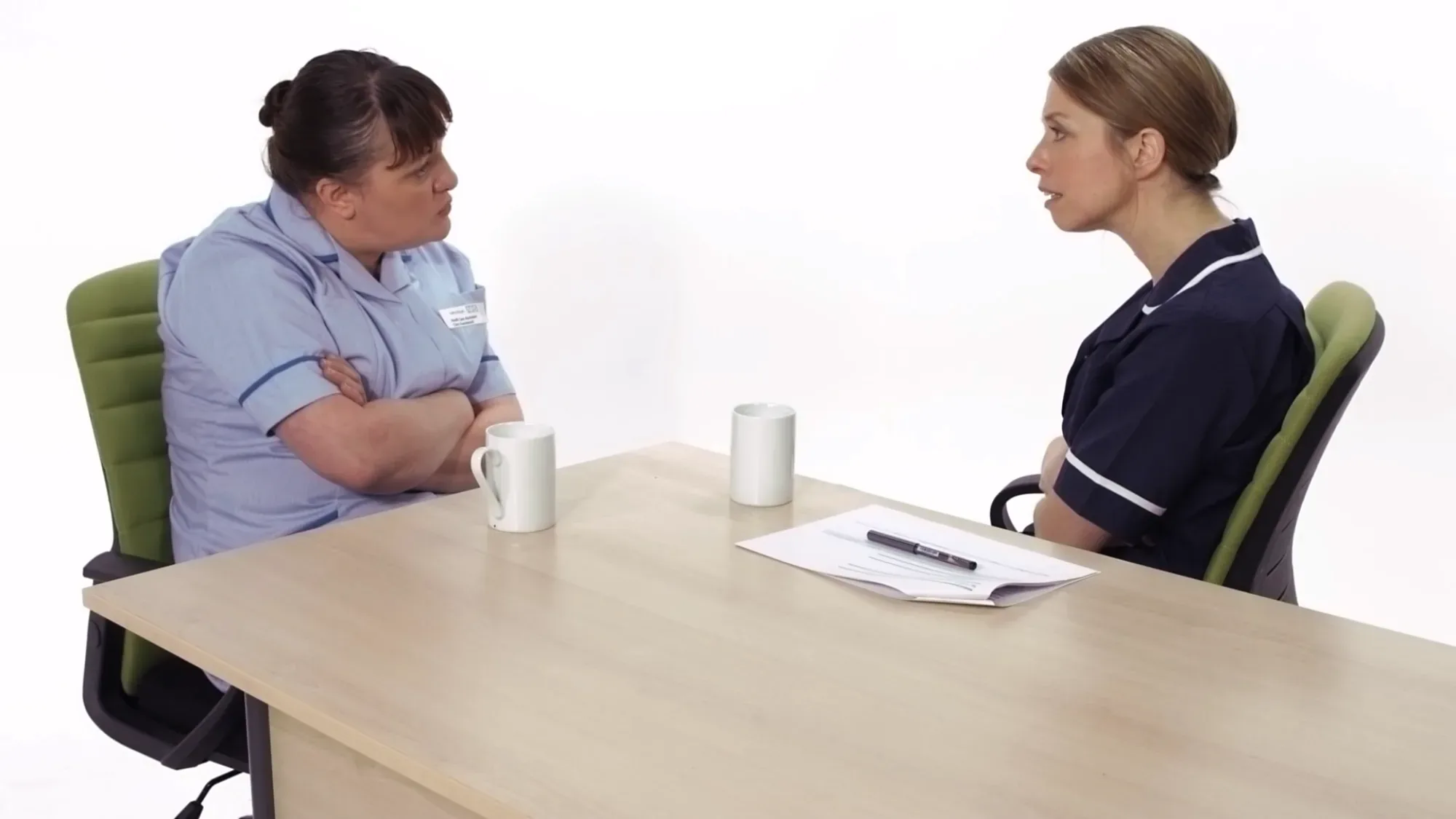
Let's have a look at how this plays out in a real conversation. You're going to see two short extracts from mid-year conversations that our manager, Sarah, is holding with members of her team. First up is Peter, who's getting some feedback from Sarah on his performance. Look carefully at the body language and listen to the tone of voice as well as the words.
Are they indicating Parent, Adult, or Child? Okay, well that sounds great. So part of your goal for this year is to make sure that infection control procedures are discussed at every shift meeting. How's that going?
Yeah. Okay. Yeah, I reckon I raise it at pretty much every meeting. But not all of them.
No. Right. But that's what you committed to at the start of the year, to raise infection control at every meeting. Yes.
Sometimes it's hard. Well, if you get to the end of the year and you can't show that you've raised it at every meeting, you're not going to be successful in that goal, are you? Now you are getting the hang of this. Let's have another go.
What's really interesting is that our ego states can also change during the course of a conversation. This time Sarah is in a meeting with Jasmine at mid-year and wants to get Jasmine to agree a change in her priorities. Look out for the shifts in ego states in both characters. Okay.
So now that we've had a look at your mid-year, there's something else I want to talk to you about. Jasmine, I need to talk to you about a change that's coming our way that's going to affect all of us for the rest of the year. Okay. I think you know that the ward manager on Surgical B has been unwell.
Yeah. And unfortunately he's now going to be off work for quite a considerable time. He's pretty poorly. Oh no, I'm sorry to hear that.
Yeah. So from next week onwards, I'm going to be covering both Surgical A and B during Michael's absence. And unfortunately that means I won't have as much time on the ward, and I'm afraid I'm going to be looking to shift supervisors to help out. Right.
There's something to worry about. I'd just really like you to take some responsibility for leading on our goal of reducing our sickness and absence rates this year. Me? Yeah.
It's really not as much extra as you might think because you're already leading on it for your team, aren't you? So this would just be taking a lead on that goal in particular across the ward team. I know that you do a really good job. Well, can't somebody else do it?
I don't really want to ask anybody else because they're already taking on extra tasks and I know this is asking a bit more of you, but I'll help out and I'm sure that between us we can sort this out. Well, I just don't think it should be me, that's all. Why not you? Well, I've already got my goal for this year and my development plan and we've just talked about how well I'm doing.
I think you've given me enough to do already and I don't want this to affect my end of year rating or my chances of getting a ward manager's job. Look, Jasmine, I know this is a change, but we all need to muck in and deal with it. And if you think about it, Jasmine, this is actually going to help you with getting a ward manager job because you can show that you've taken on wider responsibility. Well, I don't really feel that.
And if you don't do it, how's that going to look? You need to be able to show that you can be flexible, that you can adapt to new situations. Well, I think I've already shown that I can be flexible several times. I've already adapted to new situations and taken on extra responsibility.
Jasmine, what I'm saying to you is that I need this from you. In both of those examples, we end up without a productive outcome as the characters can't find a way of being in Adult: problem solving, seeking information and finding solutions. They're stuck with their tapes of "this is how you answer back when someone speaks to you like you are a child" or "this is how you deal with childish behaviour." So how do you get out of that situation where you find yourself responding from Child or Parent?
By moving into Adult: seeking to understand, being curious, showing empathy and working towards an agreed solution. Let's see what happens when a conversation gets stuck, then put back on the right track. Sarah is in her mid-year review conversation with Claire and wants to raise a concern she has about the impact of Claire's behaviour. Once again, look out for the ego states, how they shift and where Sarah and Claire end up.
One of the things that I'd like to talk about is values and behaviours, because they're very important to us here. And they'll also be part of how you are assessed at the end of the year. So that's not just what you do in your job, but how you go about doing it. Okay.
I'm raising this because I have a concern that sometimes you behave in a way that's not in line with the trust's values. Alright, that sounds serious. Yes, I think it is serious. Okay, so what have I done wrong?
On two occasions in the past week, I have observed you being abrupt with different members of the team. So when Sharon wanted help in moving a patient and then when Chris wasn't sure whether or not to report a change in a patient's condition, they both asked for your help. And on both occasions you said, "I can't, I'm busy." Do you remember?
Well, I was busy. The ward was full last week. We had loads of patients. I had loads to do.
Yes, I know you were busy. We all were. Do you feel that you had a heavier workload than the others? No.
So do you think that was an appropriate way to speak to your colleagues? I don't know. I didn't really think about it. Well, maybe you need to think about it.
Sharon was very upset. Well, maybe if we didn't have so much on and you got us more staff, we'd have more time to be polite with each other. So we've ended up with two Controlling Parent ego states arguing with each other. Now have a look at what Sarah does to get herself back into Adult, and as a result bring Claire into Adult too.
Sharon was very upset. Well, maybe if we didn't have so much on and you got us more staff, we'd have more time to be polite with each other. Okay. No, Claire, I think we've got a bit stuck here.
Maybe we got off on the wrong foot. Can we try starting again? Okay. I have a concern that sometimes you behave in a way that's not in line with the trust's values.
I've given you some specific examples and I want to say that my intent here is to let you know where I think you're going wrong, for us to discuss it and then agree what to do about it. Right. I realise that this may be hard for you to hear, and at the same time, I know you come to work every day wanting to do a good job. My concern is the impact of the way you spoke, particularly on Chris who's new to the team and still learning about the job.
I felt the way that you spoke to both of them wasn't respectful. How do you see it? Well, like I said, I was really busy. It's not that I don't respect them, I just didn't have time to help.
And if you put yourself in their shoes, when you are really busy and you want help, how do you like to be treated? I don't mind people being straight with me. I think being straight with people is fine. How do you think that Sharon and Chris felt after you spoke to them?
I don't know. Maybe they felt that I was a bit short with them. And if someone's short with you, how does that make you feel? A bit stressed.
Like they don't really care about my problem. So what would be a respectful way of dealing with them? I could have said, "I'm sorry, I can't help right now. Can we do it later?
Or can you ask someone else?" Yeah. Anything else? I suppose I could have asked how urgent it was.
You know, maybe I was only thinking about the work that I had to do. So moving forward... By starting the conversation again, explaining her intent, being curious about Claire's perspective and encouraging Claire to think it through, Sarah was able to stay in Adult and avoid getting hooked into a Parent ego state. It took a few transactions as Claire stayed in Child for a while, but then she was hooked into Adult herself.
It's not that Parent and Child ego states are always inappropriate. Sometimes people need an arm around their shoulder or some boundaries to be set, or to be playful and have a joke. The point is choosing when to draw on our Parent or Child. Generally speaking, Adult-to-Adult conversations, especially when it's a difficult subject, are more productive.
Would you like a film like this? Start a film project