


Deep Dive
Brand Services
ZeroAvia: Deep Dive Series
ZeroAvia are pushing the boundaries of engineering technology. Much of the work that they do takes existing technology and pushes it, literally, to cutting edge.
The Deep Dive Series provides an unique insight into their work.
Films
Read the transcripts
Deep Dive (film 1)
Our ambition at ZeroAvia is to not only develop hydrogen electric power trains to provide zero emission flight, but also to develop the infrastructure and ecosystem around those powertrains to allow it to be commercially adopted. And that requires solving for a couple different things. So we have to solve for the cost, we have to solve for the technical, and we have to solve for the airport operations aspects of it. We need to appeal not only to the airports, to the local municipalities and to the airport operators.
And we're developing technology which is easily permittable, which fits the operating window of our airline operators and doesn't take too much space within the existing airport ecosystem. One of the reasons why I care about trying to change, aviation and bring it into zero emissions because of the technical challenges that are within this industry and some of the hurdles that we have to do, if it was easy, everybody would do it, but because it's hard makes it all the more rewarding. So the hydrogen ecosystem is one that we're still developing in this world, and that's something where my team that I'm leading is very focused. And when we think about what the ideal version from a ZeroAvia standpoint looks like, you have co-located renewable assets which are generating green electrons.
You feed those to an ELECTROLYZER on site, and then you have a densification process, which could either be compression or liquefaction to cryogenic temperatures. We store that then airside, and then we are developing key pieces of our product roadmap, which are the mobile storage and dispensing technologies. And we have one for gas, we have one for liquid. And for these two different technologies, they are the most capitally efficient way that we can take the product onto the air airfield and we're able to actually dispense it to the aircraft with minimal losses and ensure that we get as close to a hundred percent state of charge onboard the aircraft.
Meaning you fly the furthest you can And we see it really broken into three different phases. There's the early phase, the mid phase, and the long-term vision of it. So when we think about the long-term vision, where we're trying to go, it's really about how do we make hydrogen a fungible commodity like what we see with gasoline, diesel, and jet fuel. In the mid phase, we see liquid becoming very much more prevalent and accessible in a more centralized model.
And when we come to where we are today, it's about how do we develop entry into service. 'cause currently you go to any airport in America, there's not hydrogen on site. So we're developing products within our infrastructure product roadmap such as our mobile storage and dispensers, which are most capitally efficient, to be able to bring that molecule, air side, store it, and then distribute it to the aircraft to enable zero emission flight. The airport of the future to the customer looks the exact same.
However, behind the scenes things are bustling. So we see that hydrogen will actually be produced on site, which is a complete turn of the head of the industry today. So currently jet fuel is brought in via pipeline truck, whatever the mode of transit, but it's the single largest opex that an airport has. We see hydrogen being produced onsite from green electrons that are collected there, and that can turn the single largest opex into a revenue generator for when we think about the communities who are impacted most by airports, the local surrounding, the emissions and the noise are both reduced if not fully abated.
And that's something where airports can now become more of a joining force within communities.
Deep Dive (film 2)
Hello and welcome inside the belly of our fuel cell power generation beast here at Cotswold Airport in Kemble for the first in a series of behind the scenes technology deep dives. Today we're going to walk you through how our power generation system will work for powering the first commercial zero emission aircraft in flight. We are in our ISO clean lab here where we are building our fuel cell systems for the Z A 600. The Z A 600 is a 500 to 750 kilowatts continuous class hydrogen electric powertrain, and the first commercial product from ZeroAvia.
It'll deliver zero emission flight for thousands of 10 to 19 seat class aircraft turbo props, including the Cessna Grand Caravan, Twin Otter, and Dornier 228 airframes, which will receive supplemental type certification for retrofit and line fit. The first Z a 600 equipped commuter platform will be ready for service in 2025, fueled by gaseous hydrogen tanks and capable of carrying passengers up to 300 nautical miles plus reserves. You may have seen our own breakthrough flight of our Dornier 228 test bed and other recent demonstrations. These demonstrations were all using hydrogen electric powertrains in this power class to go beyond the 20 seat aircraft.
We need more powerful engines and we will cover these technologies in a further deep dive. First, let's walk through how the system works overall as part of the powertrain. Our system is made up of four distinct parts, a hydrogen management system, power generation, power distribution, and finally, electric propulsion. Today we are most interested in the power generation system.
How do we take the compressed hydrogen stored in tanks and use fuel cell systems to create as much electrical power as possible to power the electric propulsion systems? So what are we looking at? Here is a fuel cell stack provided by our partner PowerCell. Let's begin on how fuel cells stack really works.
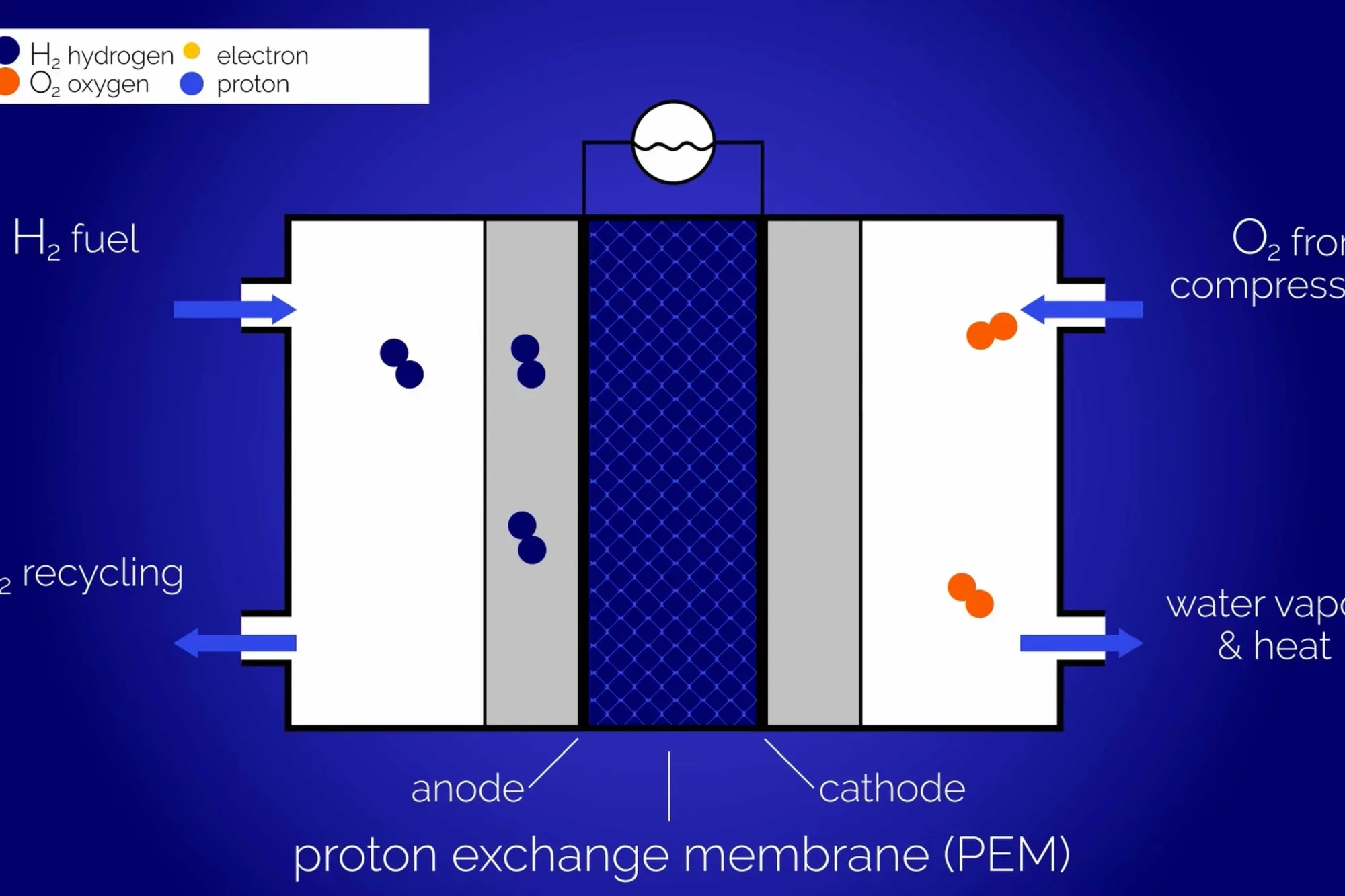
In principle, fuel cells generate electricity through an electrochemical reaction using hydrogen and oxygen with water and heat as byproducts, hydrogen fuel from our onboard storage is fed into the anode and compressed air to supply. Oxygen is fed into the cathode. A catalyst separates the hydrogen atoms into protons and electrons, which take different paths to the cathode protons pass through the membrane while electrons are being conducted in an external circuit to create the required flow of electricity. The byproducts of this process are water vapor and heat, and the average operating temperature is around 80 degrees Celsius.
To maintain the functioning of fuel cells, we need a balance of plant for these low temperature proton exchange membrane fuel cells. It consists of compressors to deliver the quantities of oxygen needed to the cathode humidifiers to control the humidity and ensure the fuel cells do not dry out or flood as well as liquid cooling and heat exchangers to prevent overheating and manage the temperature. Of course, there are also many pumps and sensors included. The low operating temperature of these fuel cells creates one of its chief advantages.
It means low wear and tear of the systems and thus enhanced durability and lower maintenance costs for larger systems flying at higher altitude. Lower temperatures will also mean we can distill and manage water vapor exhaust to prevent contrail impacts. At the same time, these lower operating temperatures also create a significant challenge as the total amount of heat rejected increases with the amount of power produced rejecting this heat becomes challenging because the temperature difference between the operating fuel cell and ambient temperatures is smaller than what you would find typically in combustion processes. Heat exchangers are critical and along with the compressors and humidifiers, they add weight to the system and thus affect the overall power density of the system.
These fuel cells are capable of high specific power at the cell level. This obviously is reduced at an overall system level, considering the weight of the balance of plant, given that these components themselves consume rather than generate power. In a typical configuration for automotive, the system level powered density is around 0.7 kilowatts per kilogram.
This is less of a concern, of course, when the vehicle does not need to take off. Our challenge is pioneering fuel cell engineers in aviation is to get the system level powered density to around 1.5 kilowatts per kilogram. Our in-house development of a balance of plant to support the fuel cell stack, which is optimized for space and weight, is part of this endeavor.
Enter the Super Stack, ZeroAvia's proprietary configuration to deliver the necessary fuel cell system for a type certified 600 kilowatt hydrogen electric engine. We have developed one of the highest power dense multi-stack modules available. The super stack module is capable of generating 400 kilowatt continuously and encapsulates many of the latest aviation fuel cell componentry technologies and offers an industry leading scalable power block, which helps us in achieving the targeted 1.5 kilowatts per kilogram specific power of the system, while the precise system architecture of the super stack remains IP sensitive.
At this point, what we have designed is a system that can make the most efficient use of shared compressor, humidifiers, and optimized cooling systems. Behind me here is our open frame testing rig, which includes components that we will package down into a ZeroAvia Super Stack. You can see here the fuel cell stack. These consists of over 900 cells connected in series.
We are developing the super stack as a self-contained line replaceable unit, including its humidification and fluid management that will be installed in the aircraft to feed air to the super stacks in our ZA 600 power plant. We use a central compressor driven by our propulsion motor. This allows us to have a compact power plant with high specific power from our first 250 kilowatt powertrain system for the six seat aircraft. We have come a long way to flight testing the fuel cell systems and our prototype Z a 600 design.
We are moving ahead at speed towards certification of this system. It is a lot of hard work for me and the team, but we are motivated by the idea that these systems could be flying passengers and cargo in commercial operations in less than three years, a totally game-changing outcome for the future sustainability of aviation. If you want to learn more or discuss our technology under nda, please get in touch via our website or alternatively, we will try to answer as many of your questions in the comments to this video or in follow up videos. We'll be really intrigued to hear your questions and views on this exciting technology development.
Deep Dive (film 3)
Hi, my name's Asif Sadik. I'm the head of Turbomachinery here at ZeroAvia. You may have already checked out our first tech deep dive that we did last year, featuring my colleague Rudolph, where we looked at our fuel cell systems to be used on the ZA 600 powertrain, which is our intended first ever zero emission engine that we wanna bring to the world. For fuel cells to operate optimally, we need the right level of oxygen at the high altitude and very extreme conditions.
That's where our air compression is very critical in our systems. Our fuel cell system necessitates aviation compression performance that is not available today in the market. And so we here at ZeroAvia designed our own. It's the world's first compressor that's designed for aviation fuel cell systems.
It will deliver a step change into the power density and stability of performance. And I'm gonna walk you through the game changing design first before we even walk through the design, let's just talk about the basics of how a compressor works. So we've all flow flown on engines today. Whether you're using a fuel cell or a combustion engine, there's a certain amount of oxygen that you need for the reaction to happen.
As we go up and altitude, that level of oxygen starts to decrease in density, which means this much oxygen ends up taking this much room. This is why it's also hard to breathe when you climb up mountains like in Colorado. And so a compressor's job is to take that oxygen, apply some energy and bring it back down to the density that it was on the ground. This allows for the reactions to occur and your system to continue to work.
The way this is achieved is compressor applies in energy. So in this case it applies the rotating energy to air and that rotating energy speeds up and increases the pressure of the air, which then increases the density of the air and that air is then fed into the systems. We can also do this by multiple forms of compressors. So there's a compressor like radial compressors, which is what you see here, also known as a centrifugal compressor.
Or we can use axial compressors, which is something you'll see commonly on jet engines. As you fly on aircraft today, smaller engines will use radial compressors, so something like a turbocharger that you'll see in your car. Our compressor was however designed, completely in-house, with some partnerships from key suppliers that supplied us testing equipment and testing infrastructure as well as manufacturing. We designed the compressor to capture the high altitude requirements, and the flow requirements and pressure requirements that the fuel cell has.
While it can operate at much higher altitudes, the real design point of this is to target systems of aircraft like the Cessna Caravan, the Twin Otter, or the Dornier 228 aircraft. And that's because that's what our Z 600 engine, is targeted to support this compressor here is an integral part to our Z 600 engine and we've designed it to operate at 15,000 feet standard ISA condition. And we have digital models that are correlated to all of our test data. So we have a CFD model, an FE, a model that already represents what's happening in real life.
Furthermore, this compressor was also designed with some of the standards that already exist in the industry. So we followed CS dash E, which is a European version of engine requirements for certification as well as far 33, which is the American equivalent of the same thing and DO-160G environmental requirements with the authorities. The reason we follow these practices is it helps for a quicker and much better transition towards an electric engine, and helps us de-risk the technology that we are using. So let's go ahead and take a closer look at our compressor and how it actually works.
So first we have an electric motor, and this motor is also used to run our propulsion unit, so your propeller would be connected somewhere on the other side of it. We then use a gearbox to change the speed of the compressor. The reason the speed of the compressor is changed is because the motor operates at a lower RPM than what the compressor does. And so having the gearbox allows both systems to operate at their most efficient RPMs.
You'll notice this compressor looks very blocky, like an eighties family car turbocharger a little bit. However, this is a prototype unit and we have a much better weight reduced model coming up in the future. And so the way this compressor works is because the motor is fixed speed, the compressor's considered fixed speed. What that means is once we hit up optimal RPM, we actually stay at that RPM.
And so if you stayed at the same RPM, you're actually stuck at a flow rate, that you have. And so the way we change our flow rates and pressure ratio is by using these vanes in the front and those vanes are called inlet guide vanes also stands as IGVs. These vanes open and close, which a affects your inlet area. And that allows more flow or less flow to come in.
And that also affects your pressure because the vanes act like an air foil. Going from that, we have a housing which then takes the flow as it comes in, there's an impeller inside, which is a disc with lots of blades on it. That spinning speeds up the flow, the housing then takes that flow, slows it down and increases its pressure, and then it comes out through an exit. And the exit doesn't have to be this way or that way it can go anyway and that exit flow goes into our system.
So this compressor is then connected to our gearbox, which is designed to the same exact standards that I mentioned before with the required reliability and life, that is specified for us. So this is our design. And this design really enables us to offer a high stable operating point across a large range of powers and different environments. By using IGVs, we increase our performance map incredibly while this compressor was sup designed for 600 kilowatt system, which would be our sub 20 seat turboprop aircraft that we're targeting.
This compressor does have the capability of supporting up to 900 kilowatts worth of fuel cell system. This helps ZeroAvia in its de-risking of future technologies like our HD EM technology. So with all of that in mind, this compressor offers us a very high power density and it's much more superior than what's available in the market today. By integrating all of this with our propulsion motor using a mechanical system, this system actually looks similar to a gas turbine today.
And so this helps us transition to electric engines much easier. So we reduce the amount of new systems that we're introducing and we continue to follow the standards and the practices that have gone on for decades that have been in jet engines that you fly on today. So there it is. That's our compressor technology.
We're really proud of that here at ZeroAvia. We've got a lot of cool tech coming out as well that will deep dive in the future. We're really excited for the first zero emission flight using this technology as well. If you have any questions, leave it in the comments.
Visit zeroavia.com to download our data sheet that we have for the compressor. And thank you for your time.